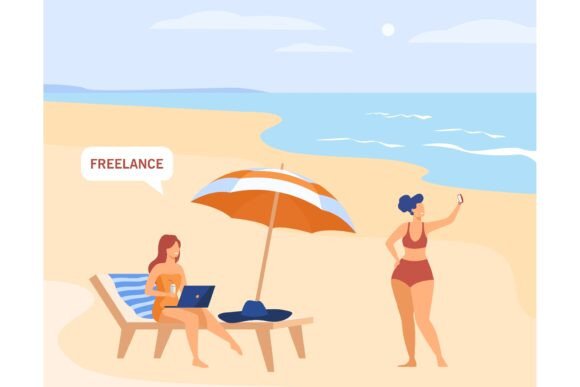
Freelance Employee Working on Vacation
The image of a freelancer typing on a laptop against the backdrop of turquoise waters has become more than just a stock photo; it represents a shifting paradigm in how we define productivity. This concept, often visualized through flat vector illustrations that fuse the tranquility of sun-soaked getaways with the dynamic world of remote work, captures a specific moment of modern aspiration. It is not merely about escaping an office cubicle but about integrating professional obligations with personal rejuvenation. For many, this freelance employee working on vacation scenario symbolizes the ultimate flexibility: the ability to earn a living while experiencing the world.
Defining the Modern Work-Travel Hybrid
At its core, the idea of a freelance employee working on vacation is about location independence. It describes a professional who leverages digital tools to maintain their workflow regardless of physical surroundings. Unlike traditional employment, which often requires a fixed presence, freelancing allows for a fluid schedule. When this flexibility meets a holiday destination, the result is a unique blend of leisure and labor. The serene backdrop of an ocean or beach, often depicted in vibrant vector art, serves as a metaphor for mental clarity and the removal of urban stressors.
However, this lifestyle is not without its complexities. It requires a high degree of self-discipline and technical reliability. The "bliss" of work and play co-existing relies heavily on the individual's ability to set boundaries. Without clear separation, the vacation can become a second workplace, leading to burnout rather than relaxation. Conversely, when managed well, it offers a refreshing perspective on time management, proving that deep focus can happen anywhere if the environment supports it.
Why Different Audiences Care About This Shift
The appeal of seeing a freelance employee working on vacation varies significantly depending on one's current career stage and goals. For the beginner entering the gig economy, this imagery serves as a powerful motivator. It illustrates the potential outcome of building a portable skill set. They see the possibility of trading a 9-to-5 commute for a sunrise view, driving them to learn new software, marketing strategies, or client acquisition techniques.
For experienced professionals, the narrative shifts from aspiration to optimization. They are less concerned with the romantic notion of the beach and more focused on the logistics. How do they maintain high-quality output with intermittent internet? How do they manage time zone differences with clients back home? Their interest lies in the practical application of this lifestyle, seeking tools and methods that ensure reliability without sacrificing the quality of their work.
Creators and designers often view this concept through an aesthetic lens. The visual representation of a freelancer at the beach—clean lines, vibrant colors, and thoughtful elements—is a staple in web design and branding. They use these themes to communicate values of freedom and balance to their own clients. A landing page featuring such imagery immediately signals to visitors that a company embraces modern, flexible working conditions.
Evaluating Priorities Across User Groups
When considering whether to adopt or promote the model of a freelance employee working on vacation, different groups prioritize different factors. Understanding these priorities helps individuals determine if this approach aligns with their specific needs.
Beginners and Hobbyists: Focus on Learning and Flexibility
For those just starting out, the primary priority is flexibility. They need a setup that allows them to test the waters without committing to rigid schedules. The learning value here is immense; they discover how to self-manage and adapt to changing environments. However, they must be wary of underestimating the effort required. The ease of use of their technology stack becomes critical. If a beginner struggles with complex cloud setups or unstable connections, the vacation dream quickly turns into a nightmare.
Practical Example: A graphic designer hobbyist might take their tablet to a cabin to finish a portfolio piece. Their goal is not necessarily to maximize profit during the trip but to prove to themselves that they can create art outside a studio. Success is measured by completion and personal satisfaction rather than billable hours.
Professionals and Entrepreneurs: Reliability and Commercial Value
Established freelancers and small business owners care deeply about reliability and commercial value. For them, the beach is just another office, and the stakes are higher. A missed deadline due to poor Wi-Fi can damage long-term client relationships. Therefore, their evaluation of this lifestyle hinges on infrastructure. They invest in satellite internet, backup power solutions, and robust project management tools.
They also consider the presentation aspect. Does working from a tropical location enhance their brand, or does it signal unprofessionalism to corporate clients? Many find that showcasing this balance attracts like-minded clients who value results over hours logged. The commercial value lies in the ability to charge premium rates for specialized skills that can be delivered globally.
Marketers and Educators: Storytelling and Engagement
Marketers and educators utilize the concept of the freelance employee working on vacation as a storytelling device. For marketers, it is about creativity and engagement. Banners and website designs that feature this theme resonate with audiences seeking work-life balance. It humanizes the brand, suggesting that the people behind the service are real humans who enjoy life.
Educators, on the other hand, use this topic to teach digital literacy and soft skills. They emphasize the importance of discipline, communication, and time management. The lesson is not just about where you work, but how you work. They help students evaluate whether they possess the internal structure necessary to thrive in such an unstructured environment.
Determining Fit for Your Goals
Deciding if the lifestyle of a freelance employee working on vacation matches your goals requires honest self-assessment. It is not suitable for everyone, nor is it the right choice for every project type.
If your work requires constant collaboration with a local team or access to physical resources, this model may hinder rather than help. High-stakes projects requiring rapid iteration and immediate feedback might suffer from the latency of travel. In these cases, the speed of execution could be compromised by environmental factors.
Conversely, if your work is asynchronous, digital-first, and outcome-based, this lifestyle offers unparalleled benefits. It provides a unique opportunity to recharge creatively. The change of scenery often sparks innovation, leading to fresh ideas that a static office environment might stifle. The key is to view the vacation not as a distraction, but as a strategic tool for maintaining long-term productivity and mental health.
A Checklist for Success
- Technical Readiness: Do you have reliable hardware and internet solutions for remote locations?
- Client Communication: Have you established clear expectations regarding availability and response times?
- Boundary Setting: Can you mentally switch off work mode to actually enjoy the vacation aspects?
- Project Suitability: Are your current deliverables compatible with a mobile workflow?
Ultimately, the fusion of work and leisure depicted in vibrant vector art is more than a trend; it is a viable strategy for those who prepare for it. Whether you are a beginner dreaming of the horizon or a seasoned entrepreneur optimizing your workflow, understanding the nuances of this hybrid model is essential. By balancing the desire for adventure with the demands of professionalism, you can create a sustainable path that honors both your career ambitions and your need for rest.