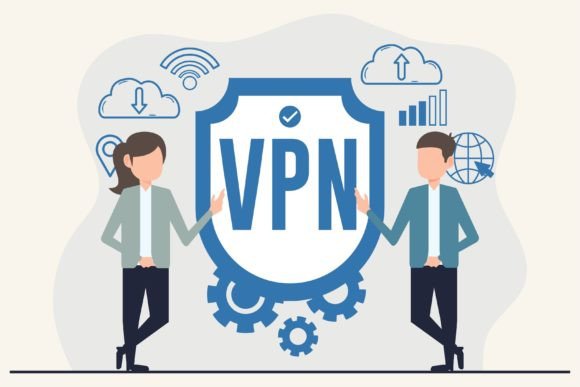
Mastering the Vpn Concept Illustration Design Flat for Modern Digital Projects
In the rapidly evolving landscape of digital communication, visual clarity is paramount. As cybersecurity becomes a central concern for individuals and enterprises alike, the need to explain complex network protocols in simple terms has never been greater. This is where the Vpn Concept Illustration Design Flat emerges as a critical asset for designers, developers, and content creators. Unlike traditional raster images that degrade when resized, these illustrations are built on a foundation of pure mathematics and vector geometry. Every element within this design template is 100% vector, ensuring that the visual integrity remains uncompromised regardless of how the image is manipulated.
The versatility of this specific design style lies in its adaptability. Whether you are crafting a high-stakes landing page for a security firm or creating an educational infographic for a classroom setting, the ability to transform, scale up or down, add or remove elements, and recolor without losing quality is a game-changer. This article explores the technical advantages, practical applications, and strategic implementation of these vector assets, providing a comprehensive guide for professionals seeking to elevate their visual storytelling.
The Technical Advantage of Vector-Based Security Visuals
Understanding the underlying technology of a Vpn Concept Illustration Design Flat is essential for appreciating its utility in professional workflows. At its core, a vector graphic uses mathematical equations to define shapes, lines, and curves rather than a grid of colored pixels. This fundamental difference offers distinct advantages over bitmap formats like JPEG or PNG, particularly when dealing with intricate concepts such as data encryption and network routing.
When a designer utilizes a file where all elements are 100% vector, they gain the freedom to manipulate the artwork at any resolution. A common challenge in web design is the "pixelation" effect that occurs when a small icon is stretched to fill a hero banner. With vector sources, this issue is entirely eliminated. You can scale a single illustration from a tiny favicon to a massive billboard-sized print advertisement, and the edges will remain crisp and sharp. This scalability is crucial for modern responsive web design, where a single asset must render perfectly on everything from a smartwatch screen to a 4K monitor.
Furthermore, the editability of these files extends beyond simple resizing. Because the components are defined by paths and nodes, a designer can easily deconstruct the illustration. If a project requires a specific color scheme to match corporate branding, the entire palette can be swapped instantly. If a particular element, such as a server icon or a lock symbol, needs to be removed or replaced, it can be done without affecting the surrounding graphics. This modularity streamlines the creative process, allowing for rapid iteration and customization that would be impossible with static image files.
File Formats and Workflow Integration
A robust design resource package typically includes 100 Vector source files in EPS formats. The Encapsulated PostScript (EPS) format is a standard in the industry for vector graphics, offering broad compatibility with major vector graphics software such as Adobe Illustrator, CorelDRAW, and Inkscape. This ensures that professionals across different toolsets can access and modify the assets without friction. Additionally, the inclusion of high-resolution JPG files provides immediate usability for contexts where vector editing is not required, such as quick social media posts or non-editable presentations.
For teams working in agile environments, having both the editable source files and ready-to-use raster versions accelerates the production timeline. Developers can drop the JPG into a prototype while designers refine the final vector assets for the live site. This dual-format approach bridges the gap between rapid prototyping and polished final delivery, making the workflow more efficient for cross-functional teams.
Strategic Applications Across Digital Platforms
The utility of a Vpn Concept Illustration Design Flat extends far beyond a single use case. Its clean, uncluttered aesthetic makes it suitable for a wide array of digital and print projects. The flat design style, characterized by minimalism and two-dimensional elements, aligns perfectly with contemporary UI/UX trends that prioritize speed and clarity.
Web Graphics and Mobile Web Optimization
In the realm of web development, load times are a critical metric for user retention and search engine ranking. Vector-based illustrations are inherently lightweight compared to high-resolution photographs. When implemented via SVG (Scalable Vector Graphics), these designs can be embedded directly into HTML code, reducing HTTP requests and improving page performance. For mobile web experiences, where bandwidth may be limited, this efficiency is invaluable. A flat VPN concept illustration loads instantly, scales beautifully on various device densities, and communicates the message of security immediately.
Landing Pages and Hero Images
The hero section of a website is the first impression a visitor receives. It must capture attention and convey value proposition instantly. A dynamic Vpn Concept Illustration Design Flat serves as an ideal hero image. By incorporating motion or interactive elements derived from the vector layers, designers can create engaging entry points that guide users toward conversion. The ability to recolor elements allows marketers to A/B test different color schemes to see which drives higher engagement, all without needing to commission new artwork.
Banners and Advertising Campaigns
Digital advertising often requires the same creative asset to appear in dozens of different sizes and aspect ratios. From a square Instagram post to a wide leaderboard banner, the flexibility of vector art ensures brand consistency. Advertisers can extract specific components from the main illustration—such as a shield icon representing protection or a globe indicating global connectivity—to create cohesive sub-assets for retargeting campaigns.
Infographics and Educational Materials
Explaining how a Virtual Private Network works involves abstract concepts like tunneling, encryption, and IP masking. Infographics are powerful tools for demystifying these topics. Using a set of 100 vector source files, educators and researchers can build step-by-step visual guides. They can isolate specific parts of the illustration to highlight a particular stage of the data transfer process. The flat style reduces cognitive load, allowing the audience to focus on the information rather than getting distracted by unnecessary visual noise.
Design Principles and Customization Strategies
While the base template provides a strong starting point, true value is unlocked through thoughtful customization. The instruction that you can transform, scale up down, add remove elements or text, recolor without lossing the quaility is the key to creating unique brand identities. However, effective customization requires adherence to certain design principles to maintain the integrity of the flat aesthetic.
Color Psychology and Brand Alignment
In the context of cybersecurity, color choices carry significant weight. Blue is often associated with trust and technology, while green suggests safety and success. Red might be used sparingly to indicate threats or warnings. When customizing a Vpn Concept Illustration Design Flat, it is essential to select a palette that reinforces the message. Since the files are fully editable, designers can apply brand-specific hex codes to every shape, ensuring the illustration feels like a native part of the company's ecosystem rather than a generic stock image.
Composition and Hierarchy
Flat design relies heavily on composition to create depth and hierarchy without the use of shadows or gradients. When adding or removing elements, one must consider the visual balance of the piece. For instance, if illustrating a connection between a user device and a secure server, the size and placement of these icons should guide the viewer's eye along the intended path. Removing clutter is just as important as adding detail; a streamlined illustration often communicates more effectively than a crowded one.
Typography Integration
Many vector templates include placeholder text or allow for easy text integration. When combining typography with the Vpn Concept Illustration Design Flat, it is crucial to choose fonts that complement the geometric nature of the graphics. Clean sans-serif typefaces usually pair best with flat vector art, maintaining the modern and professional look. Text should be legible at all scales, reinforcing the benefit of using vector formats for multi-platform deployment.
Considerations for Implementation and Maintenance
As organizations adopt these versatile assets, several considerations arise regarding long-term maintenance and version control. With 100 vector source files available, managing the library of assets becomes a task in itself. It is advisable to establish a naming convention and folder structure that reflects the usage context. For example, grouping files by application (e.g., "Mobile," "Desktop," "Print") or by component (e.g., "Icons," "Backgrounds," "Characters") can save significant time during future updates.
Additionally, while the ability to edit elements freely is a strength, it can also lead to inconsistency if multiple team members modify the same base file without coordination. Implementing a master file system where changes are made centrally before distribution ensures that the visual language remains consistent across all touchpoints. Regular audits of the design system help ensure that the illustrations continue to meet current accessibility standards and brand guidelines.
Another consideration is the balance between simplicity and detail. While flat design is minimalist, it must still convey enough information to be useful. Over-simplification can sometimes obscure the complexity of the technology being represented. Designers should test their customized illustrations with target audiences to ensure that the visual metaphor accurately reflects the functionality of the VPN service or concept being discussed.
Future Trends in Vector Illustration for Tech
Looking ahead, the role of vector illustrations in tech communication is poised to expand. As interfaces become more immersive and interactive, static images are giving way to animated vectors. The foundational work done with a Vpn Concept Illustration Design Flat can serve as the blueprint for micro-interactions and animations. Because the elements are already separated and defined mathematically, animating them in tools like After Effects or Lottie is straightforward.
We are also seeing a trend towards more personalized and dynamic visuals. Instead of a one-size-fits-all illustration, websites may dynamically generate graphics based on user behavior or location. The modular nature of vector source files supports this evolution, allowing systems to swap out components programmatically. For example, a user accessing a site from Europe might see a map illustration highlighting European servers, while a user in Asia sees a different configuration, all generated from the same master vector file.
Ultimately, the investment in high-quality, editable vector assets pays dividends in flexibility, performance, and brand coherence. Whether for a startup launching a new security product or an enterprise updating its internal training materials, the Vpn Concept Illustration Design Flat provides a robust framework for visual communication. By leveraging the power of 100% vector technology, professionals can create compelling, scalable, and timeless visuals that stand the test of technological change.